Buscar este blog

viernes, 2 de abril de 2021

ES TAMBIÉN¿ EL PAPA FRANCISCO UN RABINO BONAERENSE COMO LO FUE EL ANDIGUO PATRAIARCA ATENAGORAS DE CONSTANTINOPLAS?


PATRIARCH ATHENAGORAS OF CONSTANTINOPLE SERVED AS JEWISH RABBI WHILE ALREADY A BISHOP, NEW REPORT REVEALS

New York, April 2, 2021

Photo: 1.bp.blogspot.comPhoto: 1.bp.blogspot.com    

A new report from Orthodoxy and World Religions, a sister site of John Sanidopoulos’ well-known Mystagogy blog, reveals that the notorious Patriarch Athenagoras of Constantinople used to serve as a rabbi for Jewish friends at the same time that he was an Orthodox metropolitan.

Moreover, the Patriarch himself recalls how he used to confess to a Muslim dervish in his childhood, because they didn’t trust the local priest.

Photo: 1.bp.blogspot.comPhoto: 1.bp.blogspot.com“Many things have been written about the former Ecumenical Patriarch Athenagoras and his ecumenist activities, some of which can be viewed as positive steps, but there are also things so cringeworthy awful that one can hardly believe they are true without seeing the evidence first. One of these things is the claim that he had once served as a Rabbi to Jews at the same time he was a Metropolitan for Orthodox Christians,” Sanidopoulos begins his report.

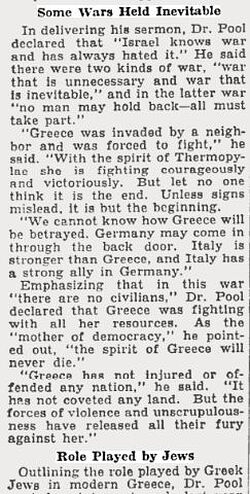
As he recalls, he was told that evidence of this claim could be found in the New York Times article, “Greek Jews Here Pray for Victory,” from November 25, 1940, when Athenagoras was Archbishop of the Greek Orthodox Church of North and South America.

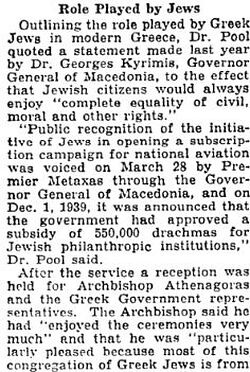
At a reception in his honor following a prayer service at a New York synagogue, Abp. Athenagoras “said he had ‘enjoyed the ceremonies very much’ and that he was ‘particularly pleased because most of this congregation of Greek Jews is from my own town of Yanina.’

“’We are of the same town and I am very proud of them,’ he added.” And he confesses: “‘In Corfu, where I once lived, I acted many times as rabbi for my Jewish friends.’”

Photo: 1.bp.blogspot.comPhoto: 1.bp.blogspot.comAs Sanidopoulos recalls, Athenagoras was a young deacon when he was elected as Metropolitan of Corfu in 1923, where he remained until moving to serve in America in 1930. Thus, by his own admission, then-Metropolitan Athenagoras served as a Jewish rabbi “many times” at the same that he was an hierarch of the Orthodox Church.

Sanidopoulos comments: “Though it is true, it is hardly surprising. Athenagoras is well-known as being an extremist as far as ecumenism is concerned, and many Orthodox faithful condemned him for it. After all, in a letter to Pope Paul VI in 1968, he not only praised the Pope for being greater than the Apostle Paul, but he also told him that he commemorated his name in every Divine Liturgy, since according to Athenagoras the Great Schism ended in 1965.”

It was Pat. Athenagoras himself who lifted the 11th-century anathema against the Pope of Rome and unilaterally declared the schism between the Orthodox Church and the Catholic church to be over.

Photo: 1.bp.blogspot.comPhoto: 1.bp.blogspot.comCanon 64 of the Holy Apostles states: “If any clergyman or layman shall enter into a synagogue of Jews or heretics to pray, let the former be deposed and let the latter be excommunicated.”

Further, Sanidopoulos writes that Pat. Athenagoras’ predecessor, Patriarch Maximos V, said that he saw Athenagoras pray in mosques in both Constantinople and in Jerusalem, and that he had told him: “In our village, we had in our paternal household two people, the priest and the dervish, the dervish Kamil. We would confess and tell our secrets to the dervish Kamil, because we had no trust in our priest.”

And Sanidopoulos concludes: “Therefore, as a child Athenagoras was raised to treat an Islamic dervish as his spiritual father above the Orthodox priest of his village. It’s no wonder his ecumenism reached such extremes, extremes that would prove to be disastrously harmful for the unity of the Orthodox world.”


“BOTH RUSSIAN AND GREEK ORTHODOX CHRISTIANS ARE PERSECUTED BY THE GODLESS OF THIS WORLD”

An Interview with His Eminence Metropolitan Isaiah of Tamassos and Orinis. Part 3

Part 1: Metropolitan Isaiah of Tamassos, on All Aspects of the Ukrainian Question

Part 2: When You Love Someone, You Tell Him the Truth

His Eminence Metropolitan Isaiah of Tamassos and Orinis gave an interview to the Romfea Church news agency, which we have translated into English in three parts, frankly answering all the questions about his position regarding the actions of Constantinople, the West, and Moscow, and also commenting on the behavior of the Archbishop of Cyprus. In the end, Metropolitan Isaiah answered how, in his view, a resolution to the “Ukrainian question” could be reached.
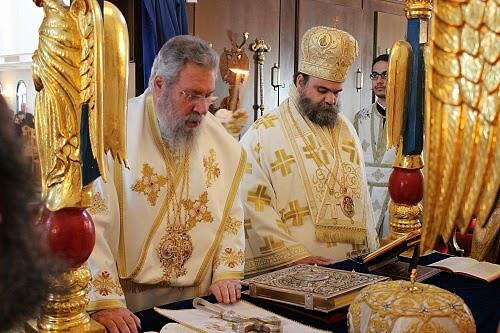
Met. Isaiah serving with Abp. Chrysostomos. Photo: philenews.comMet. Isaiah serving with Abp. Chrysostomos. Photo: philenews.com    

Your Eminence, what do you think—why did the Archbishop make such accusations against you, which led you into direct conflict with the Ecumenical Patriarchate?

—All the unacceptable things that His Beatitude said about the Metropolitans of Kykkos and Limassol and me, the Metropolitans of Kykkos and Limassol answered with reasoned and ethical answers, and I subscribe to their remarks.

The same “divide and conquer” tactic was used by His Beatitude during the previous elections to the Archbishopric too. After accusing Metropolitan Athanasius of Limassol and warning us of the danger that would befall us if we chose him as Archbishop, he then proposed the candidacy of the Metropolitan of Kykkos as an alternative. Once he had managed to inflame the situation, he made a 180-degree turn and started accusing the Metropolitan of Kykkos. He called on the Metropolitan of Limassol to “stop Kykkos on the path to the Archbishopric,” because he was supposedly even more dangerous.

Then he dropped the Metropolitan of Limassol and, playing on the contradictions, returned the Metropolitan of Kykkos, whom he had previously expelled (he confirmed this with his public confession in an interview). As a result, the Archbishop asked the Metropolitan of Kykkos to give him his votes, to make a compromise decision to elect himself for a short term (five years), because, according to him, the Church was in danger.

You should know the rest from the media. The same thing happened again in this situation with the Ukrainian issue. After regularly criticizing what he said were the authoritarian actions and character of the Ecumenical Patriarch, with whom, according to the Archbishop, only he had the courage to speak directly, he continued to polarize the atmosphere in the Synod.

He denounced both the Phanariot policy and Russian implacability.

As for the Ukrainian question, Archbishop Chrysostom initially stated that Russia is the Mother Church for Ukraine, and he supported this position at the Synod until the situation became sufficiently tense.

The Archbishop initially agreed with us about the Ukrainian question and proposed that the Cypriot Church remain neutral—for the sake of Orthodox unity and for the sake of our national question. Knowing that this position was close to us and that in no case would we deviate from neutrality, he was sure he could make us collide with the Phanar if he suddenly switched sides.

Since the majority of the Synod members disagreed with this, he started poisoning our relations with the Phanar and the West, shamelessly accusing us both in political and ecclesiastical circles, and especially before Patriarch Bartholomew, of a supposed pro-Russian position for selfish purposes—a position that he himself earlier supported, including by sending letters to the Patriarch of Moscow, which have already been published.

Once the Archbishop was sure that the political situation was favorable for him and that the majority of the votes would be for his side, he unilaterally recognized the schismatic Epiphany, dealing a heavy blow to our own autocephaly and our synodal system.

And again, just as in the archepiscopal elections, he belittled his opponents and created an environment that would help his chosen ones succeed to the archepiscopal throne.

Your Eminence, how do you feel today after all of this, and what, in your opinion, must be done to ensure that Orthodoxy not be divided and that all the Churches would return to their former peaceful coexistence? People aren’t aware of the internal affairs of the Local Churches and so they’re bewildered seeing you argue. In a few words, explain for us how we got to this point, because the Church leaders know Church history and its laws. And finally, how can we solve this problem?

—My dear, I have told you the whole truth as I perceive and understand what is happening, and so I outline these events with a clear conscience.

My feelings were wonderfully expressed by Archbishop Anastasios of Albania. Let me remind you of his position. In his interview with the Athens newspaper Kathimerini, the primate of the Albanian Church said:

The initiatives in Ukraine, after two years already, obviously did not yield the desired therapeutic effect. Neither peace nor unity was achieved for the millions of Ukrainian Orthodox. Instead, controversy and division spread to other Local Orthodox Churches… Time only worsens the trauma. The serious danger for Orthodoxy here is completely obvious: an ethnophyletistic schism (into Greeks, Slavs, and those who desire harmonious relations with everyone), which negates the multi-cultural character of Orthodoxy and its universal character. This is the greatest danger, not only for Orthodoxy, but for all of Christianity, and every possible effort must be made from all sides to eliminate it as quickly as possible… I confess that I continue to suffer when I cannot agree with my dear and respected brethren, but I am cannot ignore obvious facts and basic Orthodox principles.

I suffer just as much.

My dear, those who are not close to the Moscow Patriarchate draw hasty conclusions because they judge it just as one of the cogs in Russia’s foreign policy mechanism. But that’s not true. The Russian Orthodox, as well as the Greek, are oppressed and persecuted by the godless of this world.

They only recently escaped the persecution of communism. Therefore, they have every reason to fear the authorities and act with great caution.

Of course, they make mistakes, but they are by no means enemies of our faith.

I lived side-by-side with them for ten whole years as a student and priest, and I’ve been in contact with them for twenty-eight years overall, fulfilling the obedience of our Local Church.

They were arrested and shot; they [anti-Christian forces] tried to wipe them from the face of God, but God, as with the Greeks, did not allow this.

Just like the Phanar, they had to survive in difficult conditions. Every Local Church supports its homeland; but, of course, it shouldn’t go beyond the bounds of Orthodox theology and ecclesiology. I think some today have crossed the “red line” and gone beyond the limits of what is permissible.

I know hundreds of people whose ancestors were brutally tortured by the Soviet regime.

I have been and continue to be in close contact with pious clergy and laity who have fought and are fighting for the purity of the faith, and continue to fight and confess Orthodoxy.

Of course, they should, like the Phanariots, be careful in their contact with the state authorities; and our task is to find a way to cooperate and live together with them without harming each other.

I know many hierarchs, clergy, and laity in Russia who really love Greece. And just like us on Cyprus, they feel great pain when our primates try to persuade us to side with one or the other, as though it were a political struggle and not the common future of Orthodoxy that concerns us all.

Neither the Ecumenical nor the Moscow Patriarchates should allow non-ecclesiastical centers of interest to use us however they please and introduce “divisions” into our relations, splitting Orthodoxy into two. Such behavior is disrespectful to the martyrs and saints. As Archbishop Anastasios of Albania wisely noted, this is the greatest danger to Orthodox unity.

On the Ukrainian issue, we have indicated our position and disagreed with the views of some others. This happens sometimes with all people and in all organizations.

We also believe the Moscow Patriarchate’s refusal to attend the Holy and Great Council on Crete was a huge mistake. This could have confirmed the Ecumenical Patriarch’s fears that they want to deprive him of his primacy of honor, which would mean the existence of the Ecumenical Patriarchate would be under threat.

I repeat, and everyone should understand this: The Ecumenical Patriarchate, acting as the coordinator between the Local Orthodox Churches in universal Orthodoxy, enjoys the support of the West and survives in Turkey thanks to the recognition of and support for its authority on the international level. We want this support to continue to be there in the future.

The Russian Church, however, refrained from participating in the Crete Council and threw a double challenge to the Ecumenical Patriarchate (to which its reaction testifies, in our view).

As has been explained to us in the back rooms of the Patriarchate: first, the Ecumenical Patriarch felt that his fervent desire to hold a pan-Orthodox council was not respected; he perceived it as a betrayal and abuse of his trust, as they had promised to attend the council.

Second, the Russian Church’s refusal was interpreted as a rude act, calling into question the privileges and significance of the Ecumenical Patriarchate, and a belittling of its role of international coordinator in our time.

This step, as the Phanariot circles explained to me, was considered hostile, and the offended Ecumenical Patriarch felt that if he didn’t react immediately, the Moscow Patriarchate would deal a crushing blow to his authority, which would jeopardize the survival of the Ecumenical Patriarchate in the long term.

The international clique of interested persons was ready for the events that took place and helped the Ecumenical Patriarch, but, as it turned out later, this affected Orthodox unity.

There is, of course, another side to the coin. We’ve already discussed this when we laid out our position on the Ukrainian issue.

For many years, the Ecumenical Patriarchate enjoyed pan-Orthodox authority and recognition, not only because of its privileges, but also, to a much greater extent, because of its actions at the international level and because of its friendly relations with its brothers in the Church. Everyone recognized its privileges and took part in the dialogues it coordinated because they trusted it. The reliability and impartiality of the representatives of the Ecumenical Patriarchate created a sense of trust and tranquility in the bosom of Orthodoxy.

I believe the way in which the Ukrainian issue was resolved in these international geopolitical circumstances has seriously affected the question of trusting the Patriarchal institution, which must now find a way to rectify the situation.

Additionally, if we all now allow our Churches to be used as instruments, based on our states’ interests, then we will become like the Vatican state, we will turn into secular religious groups, and thereby cease being the Church of Christ.

The secular world seeks to devour us like a roaring lion (1 Pt. 5:8) and rob us of our sanctity. This is the greatest danger, much greater than this accursed separation.

We must never allow this to happen. The time has come to take responsibility, to agree with one another and save the ship of Orthodox unity, in the name of our Lord Jesus Christ, Who unites us all. We are brothers in Christ. We are all one family.

We are largely united spiritually, and only slightly divided by secular things.

We must rebuild our relations on the foundation of our common service to God and our conciliar system, our Orthodox theology and ecclesiology. We must all forgive one another and take responsibility for what is happening.

It’s gotten to a point where building churches is considered a “sin,” because some people interpret it from a political point of view.

It’s gotten to a point where supporting our brothers in Christ who live in our homeland is seen as a political step rather than a spiritual obligation. Alas! Where are we headed, my dears?

We have become a laughing stock for our enemies who mock our moral decline. As an Orthodox bishop, I don’t consider myself infallible, but I don’t agree with those who say I strive for anything other than the preaching of the Orthodox faith of the Gospel, and I don’t tolerate accusations of having other interests other than those I vowed to serve before the Holy Altar during my episcopal consecration.

I know that it’s hard to prove your true intentions when there’s such a clash of interests. But I will speak about them in words and prove them with my real actions, accompanied by prayer.

Orthodoxy is the greatest gift in our lives, and we insult it with our behavior.

Our task is to introduce all people to Christ, that He might be present in their everyday lives; to feed the flock entrusted to us in the spirit of Gospel love and compassion, championing the abolition of discrimination and various addictions; and to coordinate the humanitarian mission of the Church, both on the local and global level. To do this, we must first forgive one another, and then we will be able to work together in our pastoral and social ministry and tirelessly fight for the truth.

The Ukrainian question and the conflict between these two Local Churches could be resolved thanks to their love for our holy Orthodoxy.

If the two primates could keep their composure and discuss their differences in private, they would certainly find a way to soften the confrontation that has arisen.1

They could very well agree on a common strategy for de-escalating the conflict and, together with their working groups, develop scenarios for a settlement and peaceful coexistence within the framework of a theological economy acceptable to all.

And after they come to an agreement with one another, they should call a pan-Orthodox council that we might all agree together and become even stronger than before, and thrive in love and joint service to God and man.

Every time Orthodoxy faces serious international problems, its distinctive qualities remain loyalty to God and the spiritual life.

Even now, during this trial for our Orthodox faith and Sacred Tradition, we mustn’t fail if we want to convince others of the truth and holiness of the Orthodox faith.

Perhaps this trial we are undergoing now will give us the opportunity for a spiritual rebirth for the entire Church, and for every one of us. God will help us if we first take care of the purification and salvation of our immortal souls.

Cicero once wrote: “It’s hard to be silent when you’re in pain.” Sick at heart and worried about the future of Orthodoxy, I listen to the voice of my episcopal conscience and submit myself to the judgment of God and our descendants.
Emil Poligenis spoke with Metropolitan Isaiah (Kykkotis) of Tamassos
Translation from the Russian version by Jesse Dominick

Romfea.gr

4/1/2021

profanada otra iglesia en Bucarest


BUCHAREST CHURCH DESECRATED WITH BLM-ANTIFA-LGBT GRAFFITI

Bucharest, March 22, 2021

Photo: basilica.roPhoto: basilica.ro    

The wooden Church of the Descent of the Holy Spirit in Bucharest’s Alexandru Ioan Cuza Park was found to be covered in graffiti on Friday.

The vandals desecrated the icons on the outer church walls with purple spray paint and wrote “LGBT,” “#BLM,” “ANTiFA,” “BE GAY DO CRIME,” and painted an anarchy symbol together with a crossed-out swastika and a crossed-out cross.

Romanian Patriarchate spokesman Vasile Bănescu described the desecration that took place Thursday night as a new blow to the tolerance so loudly claimed by various ideological groups.

“The tolerance hysterically claimed by the ideological cores of LGBT, more recently BLM or ANTIFA, strikes again. And they do what they know best: They vandalize, defile, spit out grotesque messages and, in outbursts of supreme intelligence, write their name on all the fences, including on the walls of churches,” he said, reports the Basilica News Agency.

This is another in a long series of violent acts dictated by a “hideous (neo-Marxist) eminently anti-Christian ideology” that finds favor in the media and which progressively invades and infects the Western university and social environment which has its own adherents in Romania, Bănescu said.

Fortunately, such ideas do not reign among the normal and common-sense people of traditional Romania, the Church spokesman said, but is found among an island of people “who aren’t used to holding a book, but just graffitiing with spray paint.”

The antidote to such ideologies taking root in Romania is education “in the spirit of the values of the natural, of the authentic culture, and, of course, fertile faith in God,” Bănescu concluded.

The Romanian LGBT association ACCEPT chose to focus not on the desecration of the church but on the Church spokesman’s statement, which it characterized as “inciting hatred and full of accusations against the entire LGBTI community in Romania.

In its statement, the group accuses the Romanian Orthodox Church of supporting hate for the LGBTI community over time. “These public messages do not really call for better coexistence and social peace, but rather incite spirits to ignite in public and put LGBTI people at risk of violence and discrimination,” the statement reads.

The Church should have condemned the deed but waited for an investigation before identifying any culprits, ACCEPT writes.

jueves, 1 de abril de 2021

las contradicciones de maximo gorki

 GORKI ´S HART LIFE


He was a rebel an iconoclast portrays the suffering under the Revolution. He walked the streets barefoot and was so unlucky that he tried to commit suicide when he was 24. the shot gun pierced his lung but he survived. Alexei Peshkov (Maxim Gorki) was born in Nijni Novgorod. His father died of cholera when he was four. The story of his upbringing was narrated in “My Childhood”. molther was very poor and he ran from home. Lived in the Volga´s shores, got a job in the kitchen of an steamship.the captain gave him some books which he read avidly. At Kazan he was detained by the police due to revolutionary activities. After leaving gaol he became a trump and started to go all over Russia. That experience talking with the people was the base of his writing. Stemming from that was the force of his excellent dialog unbeatable. Obtained a job as a reporter y the Daily of Samara where he published his first stoiry Makar Chudra. Soon he was famous and very renown journalist. Arrested again in Tiflis on prison he made acquaintance with Joseph Stalin writing meanwhile Foma Gordyev. Among the poor and humble his pamphlets and novels were very popular but the Ojrana, the Secret Service, had him under suspicion and was exiled to Crimea. Anton Chejov helped him to find a job. He always was recognized to Chejov but he did not share Gorki´s revolutionary ideas. Then, member of the Communist Party, he left for the United States to collect money for the subversion. While in America he complected his master piece The Mother. That book made him millionaire and he settled in Capri. Paradoxical it was that many big cats of the Revolution lived  in luxury while the people they were supposed to defend were starving. Lenin was a classic in that respect. The Reds loved money and enjoy the affluence of capitalism. He died in Moscow of tuberculosis in 1936  

DE RELIGIÓN EN LIBERTAD LA VISIÓN DE LA BEATA EMMERICH SOBRE LA ÚLTIMA CENA


El Jueves Santo visto por esta mística católica

Jesús lo intentó todo para redimir a Judas: así vio la Última Cena la Beata Ana Catalina Emmerich

ReL

[Extractos de las visiones de la Beata Ana Catalina Emmerich (17741824) sobre los acontecimientos del Jueves Santo, redactadas por el escritor Clemente Brentano (17781842) y recogidas en el volumen La amarga Pasión de Cristo (Voz de Papel), en traducción de José María Sánchez de Toca Catalá.]

La última cena pascual

Cuando se hizo la hora y ya había llegado Judas, prepararon las mesas. Cambiaron de calzado, se pusieron la ropa de viaje ceremonial que estaba en el vestíbulo, una ropa blanca parecida a una camisa, y por encima un manto que era corto por delante y largo por atrás; se subieron la ropa hasta el cinturón y se remangaron las amplias mangas. Cada grupo fue a su mesa; los dos grupos de discípulos, en las salas laterales y el Señor, con los apóstoles en el Cenáculo. (…) 

La mesa era estrecha, y de alta, más o menos, medio pie más que la rodilla de un hombre en pie; tenía forma de sector de círculo. Enfrente de Jesús, en el lado interior del semicírculo, había un sitio libre para que pudieran servir. Si me acuerdo bien, a la derecha de Jesús estaban JuanSantiago el Mayor y Santiago el Menor; luego, en el lado estrecho de la mesa, Bartolomé y junto a él, en el lado interior de la mesa circular, Tomás y a su lado Judas Iscariote. A la izquierda de Jesús estaban Pedro, luego Andrés Tadeo; en el extremo de la izquierda, Simón, y junto a él, en el lado interno de la mesa, Mateo Felipe. (…) 

Después de la oración, el maestresala puso en la mesa delante de Jesús el cuchillo de trinchar el cordero pascual. Colocó delante del Señor una copa de vino y llenó con su jarra las seis copas que estaban entre cada dos apóstoles. Jesús bendijo el vino y bebió; cada dos apóstoles bebieron en la misma copa. El Señor distribuyó el cordero; cada apóstol le acercaba su panecillo con una especie de pinzas y recibía en él su parte. Comieron muy deprisa, troceando la carne con los cuchillos de hueso. Después quemaron los huesos. Comieron también muy deprisa los ajos y las hierbas verdes mojando en la salsa. Comieron el cordero pascual de pie, apoyándose solamente un poco en el respaldo del asiento. Jesús rompió uno de los panecillos, reservó una parte y distribuyó la otra. (...)

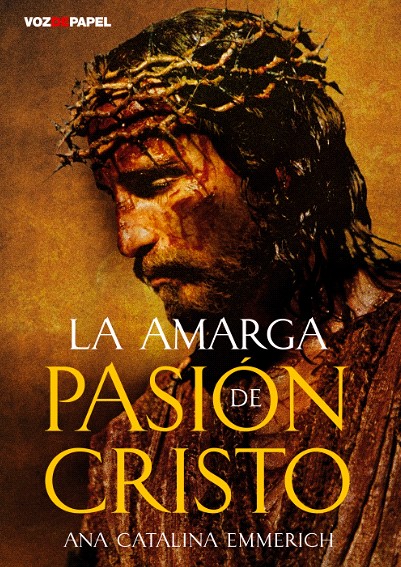
Portada de La amarga Pasión de Cristo

Puede comprar aquí el libro con las visiones de  Ana Catalina Emmerich

Bebieron de dos en dos y después cantaron; luego Jesús rezó o enseñó. Enseguida se lavaron otra vez las manos y sólo entonces ocuparon sus sitios; todo lo anterior lo hicieron de pie y muy deprisa, solo al final se apoyaban un poco. (…) 

Al principio, mientras comían, Jesús hablaba afectuosamente con ellos; pero después se puso más serio y triste y dijo:

-Uno de vosotros me traicionará; uno cuya mano está conmigo en esta mesa.

Jesús estaba repartiendo a un lado de la mesa una de las hierbas, en concreto lechuga, de la que sólo había un plato, y ordenó a Judas, que estaba frente a Él y en oblicuo, que la distribuyera al otro. Todos se espantaron mucho cuando habló del traidor y dijo:

-Uno cuya mano esta conmigo en la mesa o cuya mano moja conmigo en la fuente.

La frase quiere decir: “Uno de los doce que comen y beben conmigo; uno con el que parto mi pan”. Jesús no traicionó a Judas delante de los otros, pues mojar con la mano en la fuente era una expresión que indicaba la mayor intimidad. Sin embargo, quería dar con ello un aviso a Judas, que realmente estaba mojando la mano con él en la misma fuente para repartir la lechuga. Jesús añadió:

-En verdad el Hijo del hombre se va según está escrito; pero ¡ay del hombre por el cual será traicionado el Hijo del hombre! Mejor para él hubiera sido no haber nacido.

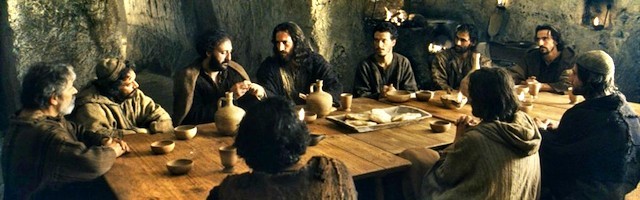
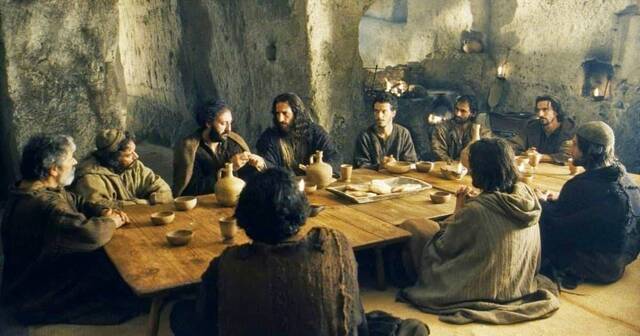
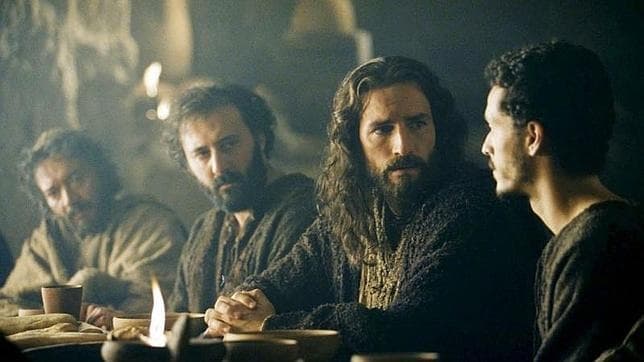
Escena de la última cena de La Pasión

Con esto los apóstoles estaban muy agitados y preguntaban a porfía:

-Señor, ¿soy yo?

Pues todos sabían que no le comprendían bien del todo. Pedro se inclinó hacia Juan por detrás de Jesús y le indicó por señas que preguntara al Señor quién era el traidor, pues él, que recibía frecuentes reconvenciones de Jesús, tenía miedo de que el Señor pensara que era él. Juan estaba a la derecha de Jesús y, reclinado como todos sobre el brazo izquierdo, comía con la mano derecha. Así tendido, su cabeza estaba cerca del pecho de Jesús. Acercó más la cabeza al pecho de Jesús y le dijo:

-Señor, ¿quién es?

Entonces supo interiormente que Jesús pensaba en Judas. No vi que Jesús dijera con los labios:

-Éste al que le doy el pan que he mojado.

Tampoco se si Jesús se lo dijo a Juan en voz baja; pero Juan lo supo cuando Jesús mojó en la salsa el pedazo de pan envuelto en lechuga y se lo acercó con mucho amor a Judas, que también preguntaba:

-Señor, ¿soy yo?

A lo que Jesús le miró con amor y le dio una respuesta en términos generales. Esta era una muestra usual de amor y confianza, que Jesús hizo de corazón y con todo amor para avisarle sin traicionarle delante de los demás, pero en su interior Judas estaba completamente furioso. Durante toda la comida ví a sus pies un pequeño monstruo que a veces le subía hasta el corazón. No vi que Juan dijera a Pedro lo que le había sabido por Jesús, pero le miró y le tranquilizó.

El lavatorio de los pies

(...) Cuando acabaron, Jesús le encargó que hiciera llevar agua al vestíbulo y el maestresala abandonó la sala con los criados. Jesús estaba ahora de pie en medio de sus apóstoles y les habló solemnemente bastante rato. (…)

Este discurso fue largo y solemne y al terminar, Jesús envió a Juan y Santiago el Menor al vestíbulo a buscar el agua que había mandado traer, y mandó a los apóstoles que pusieran los lechos en semicírculo. Luego se fue al vestíbulo, se quitó el manto, se puso una toalla alrededor del cuerpo y se la ciñó de modo que colgara el extremo más largo.

Mientras tanto, los apóstoles tenían como una especie de parloteo y hablaban todos a la vez de quién de ellos tendría el primer lugar, ya que el Señor había expresado con tanta seguridad que iba a dejarlos y que su reino estaba próximo. (…) 

Jesús entró muy humildemente por la puerta de la sala y con pocas palabras reprendió a los apóstoles por su disputa; les dijo, entre otras cosas, que Él mismo era su servidor y que debían sentarse para que pudiera lavarles los pies.

Los apóstoles se sentaron en los cojines de los lechos que servían para reclinarse y pusieron los pies desnudos en los cojines del asiento. Los lechos estaban en semicírculo y los apóstoles estaban sentados en fila en el mismo orden que en la comida. Jesús iba de uno a otro y con su mano echaba agua de la palangana que Juan le sostenía por debajo a los pies que iban adelantando uno tras otro; luego tomaba con ambas manos el extremo de la toalla que llevaba ceñida y con ella frotaba y secaba los pies. Luego se acercaba al siguiente con Santiago, mientras Juan vaciaba el agua usada en el cántaro del centro de la sala y volvía a acercarse al Señor con la palangana vacía. Entonces Jesús volvía a verter agua del cántaro de Juan sobre los pies de otro apóstol, el agua caía en la palangana de Santiago el Menor y volvía a hacer como antes.

Durante toda la cena pascual el Señor había estado extraordinariamente emocionado y amistoso, y así también estuvo, completamente lleno de amor, durante el humilde lavatorio de pies. No lo hizo como una ceremonia, sino como un acto santo de amor de corazón, con el que también expresaba su amor. (...)

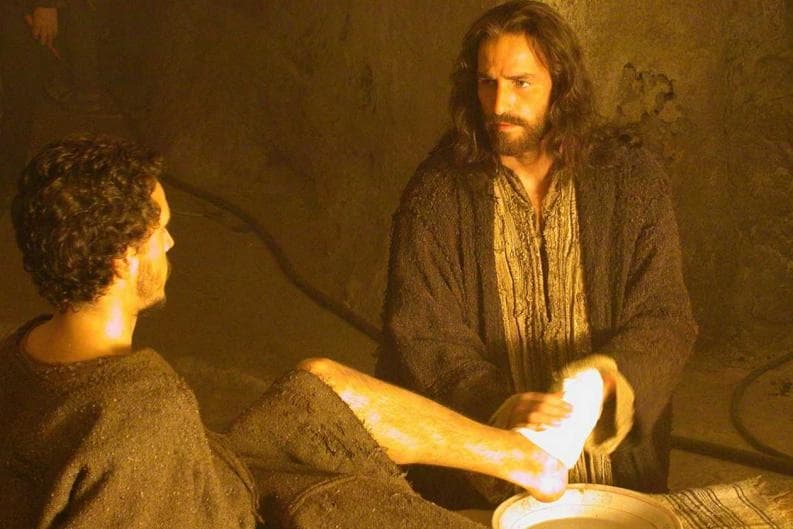
Jesús lava los pies a Juan en La Pasión

El lavatorio de los pies fue espiritual y una especie de absolución, pero Pedro, con su celo, lo tomó como una gran humillación de su Maestro. No sabía que al día siguiente, Jesús, para ayudarle, se humillaría hasta sufrir por amor la ignominiosa muerte de cruz.

Cuando Jesús lavó los pies a Judas estaba insólitamente cordial y afectuoso, apretó su cara contra los pies de Judas y le dijo en voz baja que reflexionara, que ya hacía un año que era traidor e infiel. Pero Judas no parecía querer prestar atención y hablaba con Juan. Entonces Pedro se enfadó y le dijo:

-¡Judas, el Maestro habla contigo!

Entonces Judas dio a Jesús una respuesta vaga y evasiva, como:

-Señor, ¡Dios me libre!

Los demás no se habían dado cuenta de que Jesús hablaba con Judas, pues hablaba bajo para que no le oyeran y además estaban ocupados en ponerse las sandalias. La traición de Judas fue lo que más afligió al Señor de toda su Pasión. (…)

Institución del Santísimo Sacramento

(…) Jesús se colocó entre Pedro y Juan, las puertas estaban cerradas; todo se volvió misterioso y solemne. Cuando sacaron el cáliz de la bolsa y se la llevaron a la parte separada de la sala, Jesús oró y habló solemnísimamente. Vi que Jesús les explicó la Cena y toda la ceremonia; me pareció un sacerdote que enseñara a otros a decir misa.

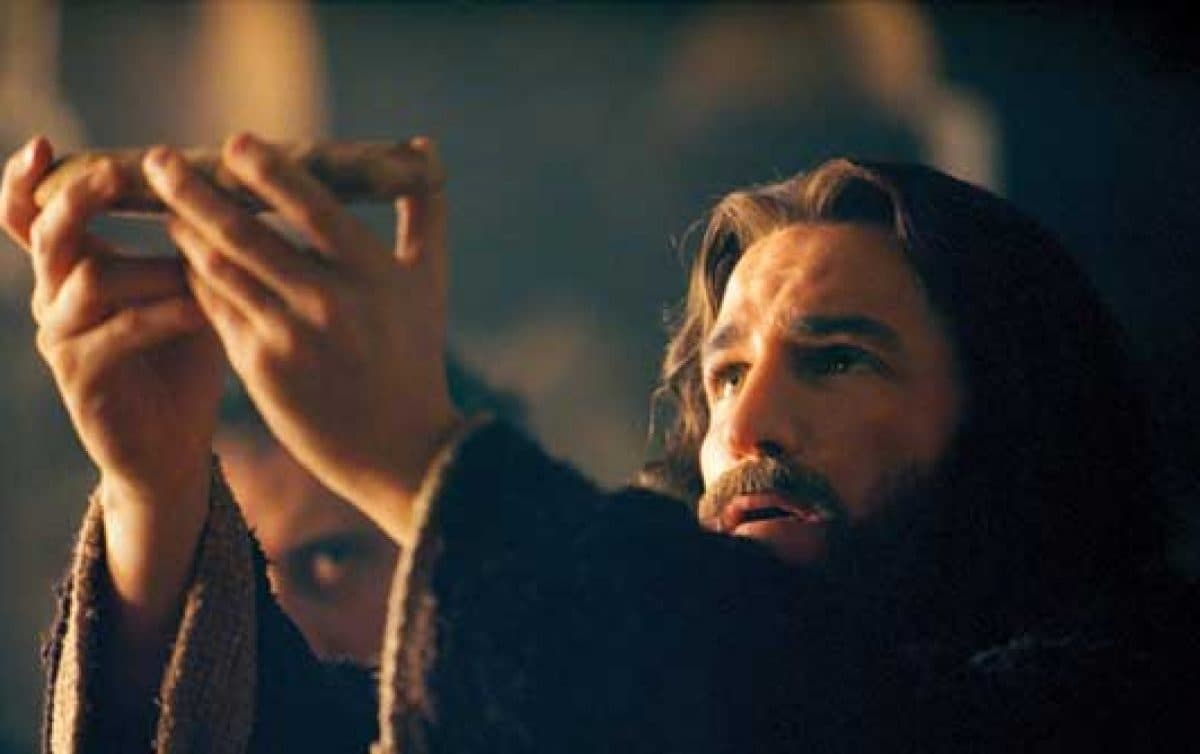
Institución de la Eucaristía en La Pasión

Sacó la patena de la bandeja donde estaban los vasos; tomó un paño blanco que cubría el cáliz y aún sobraba, y lo extendió sobre ella. Después vi que retiró de encima del cáliz la tapa redonda y la puso sobre la patena que había recubierto. Del plato que estaba al lado sacó los panecillos que habían estado cubiertos por el paño y los puso delante de sí encima de la patena; los panecillos eran rectangulares, alargados y estaban amontonados a ambos lados de la patena; la rebasaban a lo ancho.

Luego acercó un poco el cáliz y extrajo de él una copa más pequeña que tenía dentro, y a su lado puso, a derecha e izquierda, las seis copas que rodeaban el cáliz. Entonces bendijo el pan y creo que también los óleos, que estaban cerca. Elevó con ambas manos la patena con los panes, miró al cielo, rezó, ofreció, puso de nuevo la patena sobre la mesa, y la tapó. Después tomó el cáliz, hizo que Pedro echara vino en él y que Juan echara el agua que Él había bendecido antes. Añadió otro poco de agua, que echó con una cucharita, bendijo el cáliz, lo alzó orando, lo ofreció y lo volvió a dejar sobre la mesa. (…) 

Durante estos actos Jesús se mostraba cada vez más cordial y entrañable; les dijo que iba a darles todo lo que tenía, es decir, Él mismo; era como si se hubiera derretido completamente de amor y le vi volverse transparente, como una sombra luminosa. (…)

Jesús oró y enseñó más todavía y sus palabras salían de su boca como fuego y luz, y entraban en los apóstoles, excepto en Judas. Luego tomó la patena con los pedazos de pan, que no sé si la había puesto sobre el cáliz, y dijo:

-Tomad y comed; este es mi Cuerpo, que será dado por vosotros.

Al decirlo extendió su mano derecha como para bendecir, y mientras lo hacía, salió de Él un gran resplandor: sus palabras eran luminosas e incluso el pan se precipitaba en la boca de los apóstoles como un cuerpo de luz, como si Él mismo fluyese dentro de ellos; vi a todos penetrados de luz; sólo Judas estaba en tinieblas. Jesús dió el pan primero a Pedro, luego a Juan y entonces hizo señas a Judas, que estaba sentado frente a Él un poco en oblicuo, para que se acercara; éste fue el tercero a quien tendió el Sacramento, pero fue como si su palabra retrocediera ante la boca del traidor. Yo estaba tan espantada, que no puedo expresar exactamente lo que sentí entonces. Jesús dijo a Judas:

-Haz pronto lo que quieres hacer.

Luego siguió dando el Santísimo Sacramento a los demás apóstoles, que se acercaron de dos en dos; cada uno sostenía bajo el otro la pequeña cubierta rígida y ribeteada que había estado puesta sobre el cáliz.
Jesús alzó el cáliz por sus dos asas hasta la altura de su cara, y dijo para sí las palabras de la consagración. Mientras lo hacía se volvió muy claro y como transparente; era que en lo que les daba, Él pasaba a ellos.

Hizo beber a Pedro y a Juan del cáliz que tenía en las manos, y lo volvió a dejar sobre la mesa. Con la cucharita, Juan puso santa sangre del cáliz en las copitas, y Pedro se las acercó a los apóstoles, que bebieron por parejas en cada copa.

No me acuerdo bien de ésto y no estoy completamente segura, pero creo que Judas también gustó del cáliz, pero no volvió a su sitio, sino que inmediatamente salió del Cenáculo. Como Jesús le había hecho señas, los demás creyeron que le había encargado algo. Se retiró sin rezar y sin dar gracias, y así se puede ver el mal que se encarga si uno se va sin dar gracias después del pan cotidiano y del eterno. Durante toda la comida, he visto sentado a los pies de Judas un pequeño monstruo rojo, que a veces le subía hasta el corazón; uno de sus pies era como un hueso pelado. Cuando Judas estuvo ante la puerta vi tres demonios a su alrededor; uno le entraba por la boca, otro lo empujaba, y el tercero corría delante de él; era como si le alumbraran, pues era de noche y corría como un insensato. (…)

Instrucciones reservadas y consagraciones

(…) A continuación vi que Jesús ungió a Pedro y a Juan. En sus manos había vertido agua de la que había corrido por las suyas cuando instituyó el Santísimo Sacramento, y ambos habían bebido del cáliz que tenía en sus manos.

Desde el centro de la mesa dio unos pasos a un lado y les impuso las manos, primero en los hombros y luego en la cabeza, mientras ellos juntaban sus manos cruzando los pulgares. El Señor les ungió los pulgares y los índices con el ungüento y les hizo con él una cruz en la cabeza. Ellos se inclinaron profundamente delante de Él y no sé incluso si se arrodillaron; les dijo que aquello debía permanecer en ellos hasta el fin del mundo.

Santiago el Menor, Andrés, Santiago el Mayor y Bartolomé recibieron asimismo la consagración. Vi que a Pedro le cruzó sobre el pecho la estola que llevaba al cuello, y que a los demás se la atravesó sobre el pecho, desde el hombro derecho a debajo del brazo izquierdo. Sin embargo ya no se con seguridad si esto ocurrió al instituir el Santísimo Sacramento, o sólo en este momento, durante la unción.

Ví -pero esto no hay forma de expresarlo- que con esta unción Jesús les daba algo esencial y al mismo tiempo sobrenatural. Les dijo que después de recibir el Espíritu Santo ellos mismos consagrarían el pan y el vino y ungirían a los demás apóstoles. (…)

Y como Pedro se puso muy ardoroso conque él le permanecería fiel hasta el fin, Jesús le dijo:

-Simón, Simón, Satanás te reclama, quisiera molerte como trigo; pero yo he pedido por ti a fin de que tu fe no desfallezca, y para que cuando estés totalmente convertido, fortalezcas a tus hermanos.

Luego Jesús dijo que adonde Él iba no podrían seguirlo y Pedro le dijo que él le seguiría hasta la muerte. Jesús replicó:

-En verdad, antes que el gallo cante tres veces tú me negarás tres veces.

Luego, cuando les avisó sobre los tiempos difíciles que se presentaban, les preguntó:

-Cuando os he mandado sin saco, ni bolsa ni calzado ¿os ha faltado algo?

-No -respondieron los apóstoles y entonces Él dijo-: Pues ahora, el que tenga bolsa y saco, que los coja; y el que no tenga nada, que venda su vestido y se compre una espada, pues ahora se va a cumplir también aquello de “Se le ha contado entre los malhechores”. Todo lo que está escrito de Él va a cumplirse ahora.

Los apóstoles entendieron todo esto de modo corporal y Pedro le mostró dos espadas cortas y anchas como cuchillos de tajar. Jesús dijo:

-Basta, vámonos de aquí.

Entonces cantaron el himno, apartaron a un lado la mesa, y salieron al vestíbulo.

En él se encontraba su madre, María Cleofás y Magdalena, que le suplicaron ardientemente que no fuera al monte de los Olivos, pues corría el rumor de que querían apresarlo. Pero Jesús las consoló con pocas palabras, y pasó rápidamente entre ellas, serían las nueve. Bajaron rápidamente hacia el monte de los Olivos por el camino que Pedro y Juan habían seguido para llegar al Cenáculo esta mañana.